
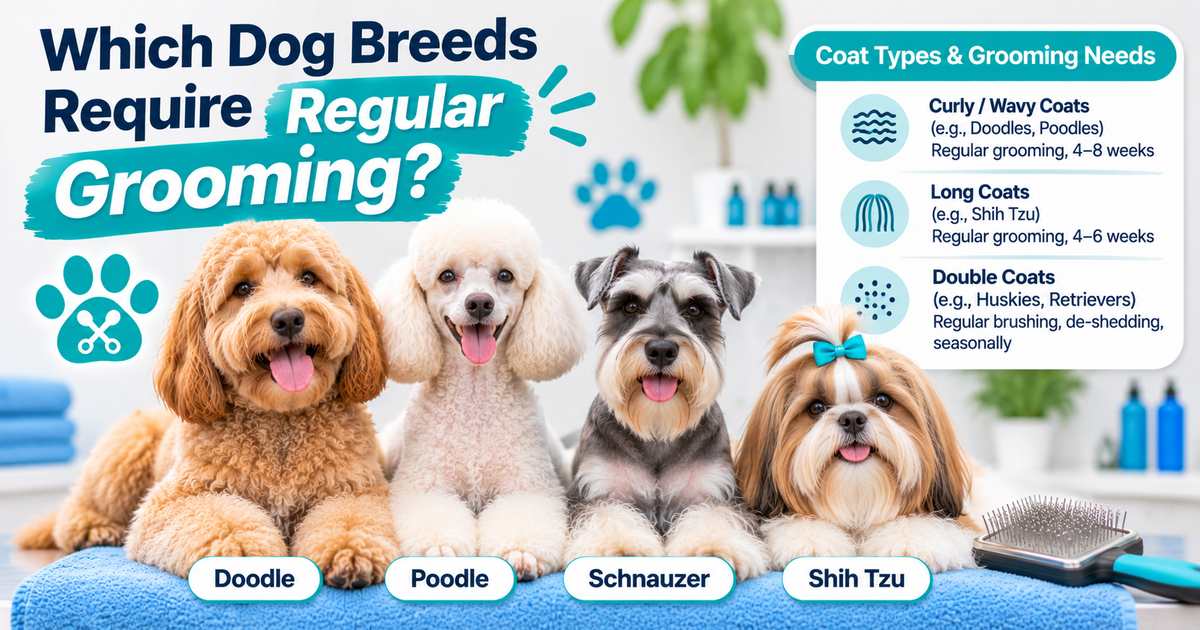
Every dog needs some grooming. What changes between breeds is how much, how often, and what happens if you fall behind. The useful way to answer this is by coat rather than by breed, because coat type is what actually drives the work, and because a mixed breed dog does not appear on any breed list. A coat that grows continuously needs cutting. A coat with a dense undercoat needs that undercoat removed. A coat that does neither needs very little. Here is how to tell which you have and what the realistic schedule looks like for each.
Coats That Grow Continuously
These are the highest maintenance coats, and the ones where falling behind has the fastest consequences.
Hair grows without a natural stopping point, the same way human hair does, so it needs cutting rather than just brushing. Shed hair stays caught in the coat instead of dropping, which is why these dogs are often described as low shedding and why they mat so readily. The hair is not falling out. It is staying in.
Breeds in this group include poodles of all sizes, doodle crosses, bichons, shih tzus, maltese, yorkshire terriers, havanese, lhasa apsos and many small mixes carrying any of these.
What these coats need: daily or near daily brushing down to the skin, and a professional appointment on a regular schedule rather than when the coat looks untidy. Gaps are where the trouble starts, and this group accounts for most of the severe matting in dogs that ends in a shave down.
Doodle crosses deserve a specific warning. The coat is unpredictable because it inherits from two very different parents, and it often changes texture between six months and eighteen months, usually becoming denser and more prone to matting. Owners who establish a routine around the puppy coat are frequently caught out when the adult coat arrives. A regular doodle grooming schedule from the start is far easier than recovering a coat that has already felted.
Double Coats
These dogs shed heavily and mat less, which makes them look easier than they are.
A double coat has a coarse guard layer over a dense insulating undercoat. The undercoat sheds in volume, and when it is not removed it packs down against the skin, traps heat and moisture, and eventually mats from underneath where you cannot see it.
Breeds in this group include german shepherds, huskies, golden and labrador retrievers, australian shepherds, pomeranians, corgis, chow chows and newfoundlands, along with their crosses.
What these coats need: regular brushing with a tool that reaches the undercoat rather than the surface, and a deshedding appointment every few months. They generally do not need haircuts, and in most cases should not be shaved, which is covered below.
Miami adds a wrinkle here. In climates with a real winter, double coated dogs shed heavily twice a year. Without that seasonal trigger, many shed at a steady moderate rate year round instead, which means a regular schedule tends to work better than waiting for a seasonal blowout that never clearly arrives.
Long Silky Coats
These coats are less work than they look, provided the brushing is consistent.
The hair is fine, long and relatively sparse compared with a double coat, and it tangles at the friction points rather than felting across the whole body. Breeds include afghan hounds, setters, cocker spaniels, cavaliers and long haired dachshunds.
What these coats need: gentle regular brushing with a pin brush, particular attention to ears, armpits, the chest and the feathering on the legs, and professional trimming to keep the length manageable.
Ears are the recurring issue in this group. Long, heavy, hairy ears limit airflow and hold moisture, which is a direct route to ear problems in a humid climate. Keeping the hair around the ear opening clear matters more for these dogs than for most.
Wire Coats
This group is small, and it is the one where the method matters as much as the frequency.
Wire coats are coarse and harsh by design, with a softer undercoat beneath. Breeds include schnauzers, most terriers, wirehaired pointers and airedales.
The complication is that a wire coat is traditionally maintained by hand stripping, which removes dead hair at the root and allows the coarse texture to grow back. Clipping cuts the hair instead, which leaves the softer undercoat dominant. A clipped wire coat gradually becomes softer, duller in color and more prone to matting, and the change is slow to reverse.
Neither approach is wrong. Hand stripping preserves the coat and takes longer. Clipping is faster and more comfortable for many dogs, particularly older ones, at the cost of texture. What matters is knowing which you are choosing, because most owners are never told there was a choice. Schnauzer grooming is the most common case where this comes up.
Short Smooth Coats
The lowest maintenance group, and still not zero.
Breeds include beagles, boxers, dalmatians, pugs, french bulldogs, greyhounds and most pit bull type dogs. These coats shed constantly, sometimes more than people expect, but they do not mat and they do not need cutting.
What they need: a rubber curry or bristle brush weekly to lift loose hair, regular nail trims, and baths as required. That is close to the whole list.
Two exceptions worth naming. Wrinkled breeds such as pugs, bulldogs and french bulldogs have skin folds that need cleaning and drying regularly, since moisture collects in them and causes infections. And several breeds in this group have skin that is sensitive enough that shampoo choice matters more than their coat suggests.
What Every Dog Needs Regardless of Coat
Some jobs are universal, and they are the ones owners most often leave too long.
Across every coat type:
- Nails at a length that does not touch the floor when the dog stands
- Ears checked and kept clear, more often for floppy or hairy ears
- Hair between the pads kept clear
- Teeth attended to in some form
- Skin checked regularly for lumps, parasites and sore patches
- A sanitary trim for longer coated dogs
Nails are the most neglected item on that list and the one with the clearest effect on comfort. Overgrown nails hit the floor before the pad does, which changes how a dog distributes weight and how it stands. A short smooth coated dog that never needs a haircut still needs Dog Nail Trimming in Miami on a regular basis.
Why You Should Not Shave a Double Coat
This comes up every summer in Miami and deserves a direct answer.
A double coat insulates in both directions. It slows heat coming in as well as going out, and it shields skin from sun. Shaving it does not make a dog cooler in any reliable way, and it removes that protection.
It also does not stop shedding. The hair still dies on schedule, it is just shorter when it lands on your floor.
The regrowth is the lasting problem. A shaved double coat frequently grows back unevenly, with the undercoat returning faster than the guard coat, and the texture can stay altered for a long time or permanently in older dogs.
The correct approach for a hot climate is to remove the dead undercoat so air can circulate, not to remove the coat. Single coated dogs are an entirely different case, and a shorter cut is a perfectly reasonable choice for them.
Choosing a Dog by How Much Grooming You Want
Worth saying plainly for anyone reading this before getting a dog rather than after.
Grooming cost and effort are part of owning a dog, and they vary enormously by coat. A continuously growing coat means a lifetime of regular professional appointments and daily brushing between them. A short smooth coat means almost none of that. Neither is better, but one of them is a standing commitment that catches people out.
If daily brushing is not realistic for your household, that is useful to know before choosing a breed rather than after the first mat. It is also a reasonable thing to raise with a groomer, who will give you a franker answer than most breeders will.
Finding the Right Schedule in Miami
The schedule that works is the one that fits the coat in front of you, which is not always the one the breed charts suggest. Mixed breeds inherit unpredictably, coats change with age, and the humidity here pushes most coats harder than the general advice assumes. If you would like someone to look at your dog’s coat and tell you what it actually needs, Barky Lounge is a Dog Groomer Miami salon at 275 NE 18th St in Edgewater. Appointments on (786) 409-2885 or through the booking page.
Frequently Asked Questions
Which dog breeds need the most grooming?
Breeds with continuously growing coats need the most: poodles, doodle crosses, bichons, shih tzus, maltese, yorkshire terriers and havanese. Their hair does not stop growing and shed hair stays trapped in the coat rather than dropping, so they need near daily brushing and regular professional appointments.
Do short haired dogs need professional grooming?
Less often, but not never. Short smooth coats do not mat and do not need cutting, so weekly brushing at home covers most of it. They still need nails, ears, feet and skin attended to, and wrinkled breeds need their skin folds cleaned and dried regularly to prevent infections.
How often should a doodle be groomed?
Doodles need daily brushing down to the skin plus regular professional appointments, and the schedule matters more than for almost any other coat. The coat usually changes texture between six months and eighteen months, becoming denser and more prone to matting, which catches out owners who set a routine around the puppy coat.
Should I shave my double coated dog in summer?
Generally no. A double coat insulates against heat as well as cold and protects skin from sun, so shaving does not reliably cool a dog. It also does not stop shedding, and the coat often grows back uneven in texture. Removing dead undercoat so air circulates is the better approach.
Leave A comment