
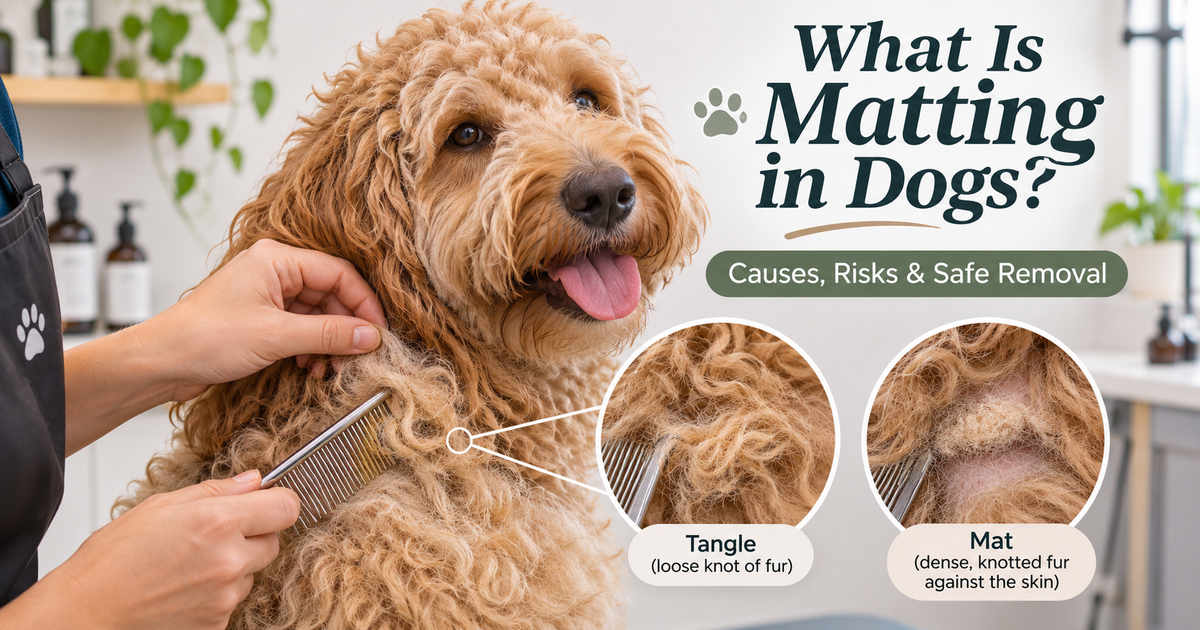
Matting in dogs is fur that has twisted and tightened into a dense knot that sits against the skin and will not comb out. It is not the same as a tangle, and that difference is why owners are often surprised when a groomer says the coat has to come off. A mat pulls on the skin every time your dog moves, holds moisture underneath it, and hides whatever is going on below. Most owners only notice once the mat is firm enough to feel through the coat, by which point it has usually been forming for weeks. Here is what matting actually is, how it starts, what it does to a dog, and what happens at the salon when a matted dog comes in.
What Matting in Dogs Actually Is
A coat is made of hairs that shed and regrow constantly. When a loose hair does not fall away, it stays caught in the coat around it. Friction and movement twist those loose hairs together with the growing ones, and the knot pulls tighter with every step, every scratch and every harness buckle. Over time the knot compresses into a flat, felted pad that sits flush against the skin. That last part is what makes a mat different from a tangle. A tangle sits in the coat and lifts away from the body. A mat is anchored to the skin at its base, which is why pulling at one hurts. Professional salons treat matting as a skin condition, not a styling problem, and it is one of the most common reasons dogs are brought in outside their normal schedule at a Dog Grooming Miami salon.Why Mats Form in the First Place
Matting almost never comes from one cause. It builds from several small things happening at once, usually without the owner noticing any of them. These are the most common reasons a coat starts to mat:- Brushing that only reaches the top layer of the coat and leaves the undercoat untouched
- A coat that is bathed and then air dried, which lets damp hair twist as it dries
- Harnesses, collars and clothing that rub the same spot every day
- A dog that licks or scratches one area repeatedly
- Shedding season, when loose undercoat has nowhere to go
- Long gaps between professional appointments, especially for coats that do not shed
- Swimming or heavy humidity, which matters year round in Miami
Where Mats Show Up First
Mats start in the places that get the most friction and the least brushing. Owners tend to brush the back and the sides, which are the easiest parts to reach, and miss everywhere else. Check these areas first:- Behind and inside the ears
- Under the collar and under the harness straps
- The armpits and the backs of the legs
- The chest and the ruff
- The sanitary area and the base of the tail
- Between the pads and around the toes
Why Matting Hurts More Than It Looks
From the outside a mat looks like a cosmetic problem. Underneath, it is doing several things at once. A mat pulls the skin in whatever direction the dog moves. On a tight mat that pull is constant, and over a large area it changes how a dog stands and walks. Many owners describe a matted dog as slowing down or getting grumpy about being touched, and that is usually what is behind it. A mat also seals moisture, dirt and skin oil against the skin and blocks air from reaching it. That creates conditions for irritation, hot spots and infection, and it is a common place for fleas and ticks to go unnoticed. Because the mat covers the skin completely, sores, lumps and bites underneath can go undetected until the mat comes off. Severe matting restricts circulation in the places it wraps around, which is why mats on ears, tails and feet get attention first. None of this is visible from above the coat, which is the part that makes matting hard for owners to judge.Tangle or Mat? How to Tell the Difference
The test is simple and takes a few seconds. Slide a comb into the coat down to the skin, then try to draw it through to the tip. If the comb passes with light resistance, that is a tangle, and brushing will clear it. If the comb stops, lifts the skin, or cannot get to the base at all, that is a mat. If you can lift the knot and see a clear gap between it and the skin, you probably have time. If the knot is flat against the body and the skin moves when you tug it, it has set. One more check matters: run your hands over the whole dog, not just the top. A coat can look perfectly groomed from above and be felted solid underneath, which is the single most common surprise at drop-off. If you are working on knots at home, our guide on removing matted hair from a dog covers the safe way to do it.Which Coats Mat the Fastest
Coat type decides how quickly matting sets in, far more than breed popularity or how much a dog sheds. Coats that mat quickly include curly and wavy coats such as poodles and doodle crosses, where shed hair stays trapped in the curl instead of falling out. Long silky coats mat at the friction points even when the rest looks fine. Double coats mat in the undercoat, out of sight, especially during a shed. Wire coats mat when they are clipped rather than stripped, because the softer regrowth tangles more easily than the original texture. Short smooth coats rarely mat at all, though they still shed and still benefit from regular brushing. The practical takeaway is that a doodle and a short-haired terrier do not belong on the same schedule, and the length you ask for changes the schedule too. A shorter Dog Haircut in Miami is easier to maintain between appointments than a long one, which is worth discussing with your groomer before the clippers come out rather than after.What a Groomer Does With a Matted Coat
When a matted dog comes in, the first thing a groomer does is check the coat down to the skin across the whole body, not just where the mats are obvious. That check decides everything that follows. Light matting that is still lifting off the skin can usually be worked out. The groomer separates the mat in sections with their fingers and a comb, working from the tip of the hair inward so the pull never reaches the skin. It is slow, and it is the part of a dematting appointment that takes the time. When matting is tight against the skin, or covers a large area, the safe answer is to clip the coat short underneath the mats and start the coat over. That decision is about comfort, not appearance. Working a set mat out by force means hours of pulling on skin that is already sore, and the skin underneath is often too fragile for it. A responsible salon will tell you this at drop-off rather than after. What is underneath also matters. Once the mats come off, the skin usually needs a look: redness, hot spots, scabs and parasites are common finds, and a groomer will point them out and tell you when something needs a vet rather than a salon. If you want to see how this works in practice, our dog dematting in Miami page covers what the appointment involves. Two things are worth knowing before you book. A dematting appointment takes longer than a standard groom, so expect a longer booking. And a coat that has been clipped short grows back, which is a point many owners need to hear before they agree to it.How to Keep Mats From Coming Back
Prevention is mostly about reaching the layer of coat you cannot see. These habits do most of the work:- Brush down to the skin in sections, lifting the coat and working from the skin outward, rather than sweeping across the top
- Use a comb after the brush, as a check: if the comb will not pass, the brush missed that spot
- Dry the coat fully after a bath or a swim instead of letting it air dry
- Check the friction points weekly, since those are where mats start
- Take the collar or harness off at home when you safely can, and check under it when it goes back on
- Brush more often during a shed, not less
- Keep a regular appointment schedule instead of booking only when the coat looks bad
Help With a Matted Coat in Miami
Matting happens to attentive owners all the time. Coats change with the seasons, with age and with a dog’s habits, and a schedule that worked last year can stop working without any obvious warning. Finding a mat is not a reason to feel bad about it. It is a reason to get the coat checked before the mat sets. If your dog’s coat is knotting and you want someone to look at it, Barky Lounge is at 275 NE 18th St in Edgewater, Miami, and appointments can be made by phone on (786) 409-2885 or through the booking page.Frequently Asked Questions
Is matting bad for dogs, or is it just a cosmetic problem?
It is not cosmetic. A mat pulls on the skin whenever the dog moves, traps moisture and dirt against it, and blocks air from reaching the skin underneath. That combination leads to irritation and sores, and it hides fleas, ticks and lumps from view. Tight matting also restricts circulation in ears, tails and feet.What does matted mean for dogs, exactly?
Matted means shed hair has twisted together with growing hair into a dense knot that sits flat against the skin and cannot be combed out. The distinction from a tangle is where it sits. A tangle lifts away from the body and brushes free. A mat is anchored at the skin, which is why pulling at it hurts.Can mats be brushed out at home?
Small mats that still lift away from the skin can often be worked out with patience, a comb and a detangling product. Mats that sit flat against the skin should not be attacked at home, and scissors should never go near one, since the skin lifts into the mat and is easy to cut without seeing it.Why does my groomer want to shave my dog instead of brushing the mats out?
Because working a set mat out means hours of pulling on skin that is usually already sore, and the skin underneath a heavy mat is often too fragile for it. Clipping below the mats removes them in one pass with no pulling. The coat grows back, and most dogs are visibly more comfortable immediately afterward.More Dog Grooming Guides
Practical guides from our groomers in Edgewater, Miami, on keeping your dog's coat, nails, and skin in good shape between appointments.
Grooming appointments
Bathing and coat care
Barky Lounge is a dog grooming salon and pet store in Edgewater, Miami. One dog at a time, open daily 9am to 8pm, with free parking on site.
[…] looks untidy. Gaps are where the trouble starts, and this group accounts for most of the severe matting in dogs that ends in a shave […]
[…] that section before moving on. If the comb will not pass, go back. This one habit prevents most matting in dogs that otherwise turns into a shave […]
[…] find hair on the floor or knots in the coat. Hair on the floor points to deshedding. Knots point to matting in dogs, which is a different problem with a different […]