
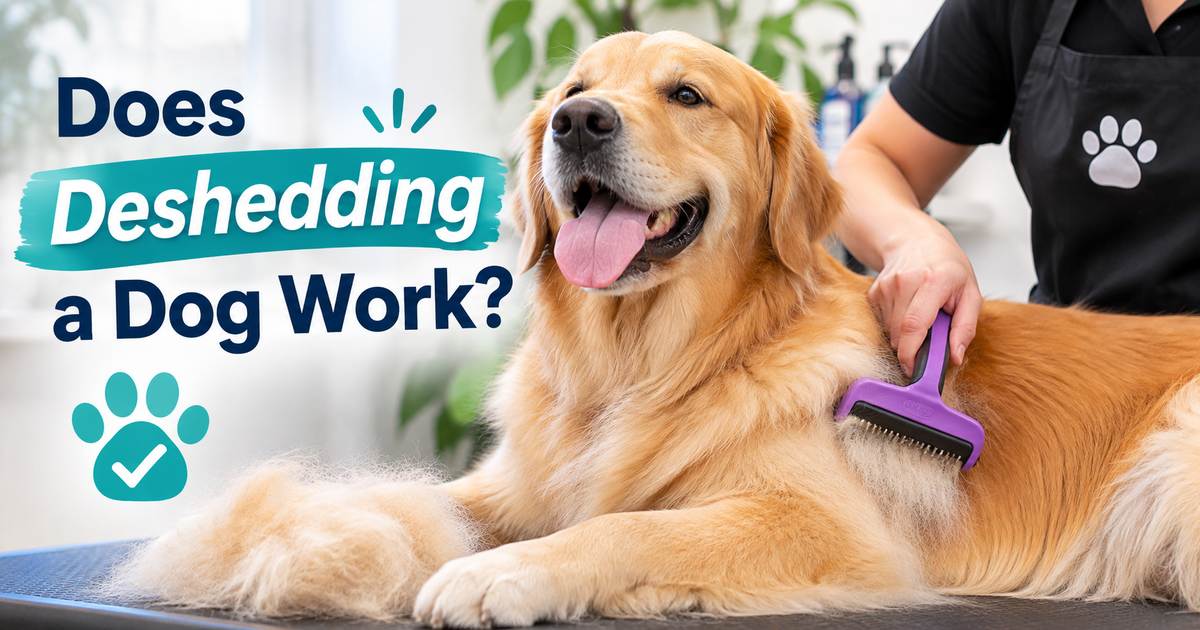
Deshedding works, but not in the way the name suggests. It does not stop a dog from shedding, and nothing does, because shedding is how a coat replaces itself. What a deshedding treatment does is pull out the hair that has already died and is sitting loose in the undercoat, waiting to fall. Remove it at the salon and it does not come out on your couch over the following three weeks. That is the whole mechanism, and it is why results vary so much between dogs: a coat with a heavy undercoat gives up a startling amount of hair, and a coat without one gives up almost nothing.
What Deshedding Actually Removes
A double coated dog has two layers. The outer layer is the guard coat, which is coarse and protective. Underneath it is a dense, soft undercoat that insulates. The undercoat is the layer that sheds in volume.
When undercoat hair dies, it does not fall straight out. It stays trapped in the surrounding coat and works loose gradually, which is why shedding looks like a constant slow leak rather than an event. A deshedding treatment short circuits that process by lifting the dead hair out in one session.
Nothing is being cut. That distinction matters, because owners sometimes expect a deshedding appointment to leave the dog looking shorter. It does not. The dog looks cleaner and the coat sits flatter, but the length is unchanged. A deshedding appointment at a Dog Grooming Miami salon is about removing what is already loose, not about changing the shape of the coat.
How Much Hair It Actually Removes
This is where expectations need setting honestly.
On a thick double coated dog in a shed, the amount of hair that comes out is often hard to believe. Owners frequently ask whether their dog has any coat left. They do. The guard coat is intact, and so is the live undercoat. What came out was dead hair that had nowhere to go.
On a single coated dog, the results are modest. There is no undercoat to strip, so the appointment amounts to a thorough bath and brush out. That is still useful, but it is not the dramatic result the treatment is known for, and any salon telling a poodle owner otherwise is overselling it.
The practical measure is what happens at home afterward. Most owners notice a clear drop in loose hair on furniture and clothing for a few weeks, then a gradual return as new hair dies off and works loose.
Which Dogs Benefit Most
Coat type decides almost everything about whether this treatment is worth booking.
Dogs that benefit most have a dense undercoat that sheds seasonally or year round:
- Northern breeds with heavy double coats
- Retrievers and other sporting breeds
- Herding breeds with thick ruffs and feathering
- Short coated dogs that shed constantly, such as many of the bully breeds
- Mixed breed dogs with any of the above in them
Dogs that benefit least are the ones that do not shed much in the first place. Curly and wavy coats hold shed hair in the curl rather than dropping it, which is why they mat instead of shedding. For those coats the problem is knots, not loose hair, and the right appointment is a brush out or a trim rather than a deshed.
If you are not sure which category your dog falls into, the rough test is whether you find hair on the floor or knots in the coat. Hair on the floor points to deshedding. Knots point to matting in dogs, which is a different problem with a different solution.
What Happens During a Deshedding Appointment
The treatment is mostly about the bath and the dry, not the brush, which surprises most owners.
The work runs roughly in this order:
- A pre-brush to clear surface tangles, so water can reach the skin
- A bath with a shampoo and conditioner chosen to loosen the undercoat
- Product left on the coat long enough to work, rather than rinsed straight off
- A thorough rinse, since residue trapped in a dense coat causes itching
- A force dry, which blows a large share of the loose undercoat out of the coat entirely
- A final brush and rake to collect what the dryer left behind
The force dry does the heaviest lifting. A dog that is air dried or towel dried keeps most of its dead undercoat, which is the main reason a bath at home never produces the same result as a salon appointment even when the same brushes are used.
How Long the Results Last
Expect a few weeks of noticeably less hair, then a gradual return to normal.
The reason is simple. The treatment clears what is dead right now. It does not affect the hair that is still alive and will die over the following weeks. As that hair dies, it works loose, and shedding resumes at its usual rate.
Most double coated dogs do well on a deshedding appointment every few months, with more frequent appointments during a heavy seasonal shed. In Miami, where there is no real winter to trigger a clean seasonal change, double coated dogs often shed at a steady moderate rate all year instead of in two big bursts, which tends to mean a regular schedule rather than a seasonal one.
Deshedding at Home, and the Mistake to Avoid
Brushing at home between appointments helps a great deal, as long as the tool suits the coat.
An undercoat rake reaches the layer that actually sheds. A slicker brush tidies the surface but does not reach far enough on a dense coat. A deshedding blade with teeth does reach, and it is also the tool most often overused.
That is the mistake worth naming. Those blades cut hair as well as pull it, and repeated hard passes over the same area thin the guard coat and can leave the skin sore. Used lightly once a week they are fine. Used daily with pressure they damage the coat, and the damage takes months to grow out. If you are unsure which rake or brush suits your dog, the staff at our Pet Store in Miami can match one to the coat rather than guessing from the packaging.
One rule that applies to every tool: never work a deshedding tool through a coat that is matted. The tool catches on the mat and pulls against the skin. Clear the mats first.
Why Shaving Is Not a Shedding Fix
It is tempting, especially in Miami heat, and for a double coated dog it usually backfires.
Shaving does not stop shedding. The hair still dies on schedule, it is simply shorter when it lands on the floor. More importantly, the double coat works as insulation in both directions, keeping heat out as well as in, and it protects the skin from sun. Removing it can leave a dog hotter and more exposed, not cooler.
There is also the regrowth problem. A shaved double coat often grows back unevenly, with the undercoat returning faster than the guard coat, and the texture can stay changed for a long time afterward.
Single coated dogs are a different case entirely, and a shorter Dog Haircut in Miami is a perfectly reasonable choice for them. The distinction is the undercoat, which is exactly why coat type should decide the appointment rather than the forecast.
When Shedding Is Not Just Shedding
Heavy shedding is usually normal. A few patterns are not.
Worth a vet visit rather than a salon appointment: bald patches or thinning in specific spots, shedding alongside red or flaking skin, hair that comes out in clumps leaving visible skin, constant scratching or chewing, or a sudden change in how much a dog sheds with no seasonal explanation.
Shedding is driven by daylight, temperature, nutrition, stress and health, so a change in any of those can shift the pattern. A groomer sees a lot of coats and will usually tell you when something looks like a skin issue rather than a coat issue, but the diagnosis belongs with a vet.
Booking a Deshedding Appointment in Miami
The honest summary is that deshedding is maintenance, not a cure. It will not end shedding, and anyone promising that is selling something. What it does reliably is remove weeks of dead undercoat in one appointment, leave the coat lighter and better ventilated, and cut down what ends up on your floor in the meantime.
If your dog is leaving hair on everything and you would like the undercoat dealt with properly, Barky Lounge is at 275 NE 18th St in Edgewater, Miami, and appointments can be made on (786) 409-2885 or through the booking page.
Frequently Asked Questions
Does deshedding actually stop a dog from shedding?
No, and nothing does. Shedding is how a coat replaces itself. A deshedding treatment removes the dead undercoat that is already loose, so it falls out at the salon instead of around your home over the next few weeks. Most owners see a clear reduction for a few weeks, then a gradual return.
What does deshed mean in dog grooming?
Deshedding means removing loose, dead undercoat from the coat without cutting it. It is done with a bath using products that loosen the undercoat, a force dry that blows the dead hair out, and a rake or brush to collect the rest. The coat keeps its length throughout.
How often should a dog have a deshedding treatment?
Most double coated dogs do well every few months, with extra appointments during a heavy shed. In a climate with no real winter, shedding tends to run at a steady rate all year rather than in two bursts, so a regular schedule usually works better than a seasonal one.
Is a deshedding brush safe to use at home?
Yes, used lightly and not every day. Bladed deshedding tools cut hair as well as pull it, so repeated hard passes over the same spot thin the guard coat and can irritate the skin. An undercoat rake is gentler for regular use. Never run either tool through a matted coat.
Leave A comment