
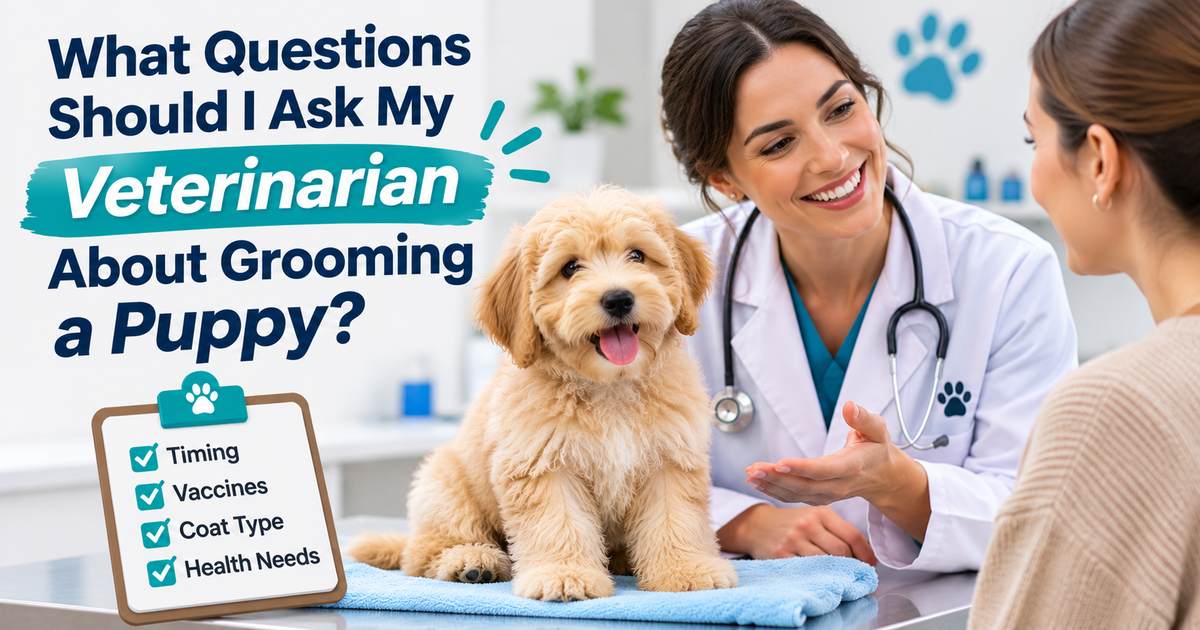
Your vet sees your puppy’s skin, coat and vaccination record before any groomer does, which makes them the right person to ask a few specific questions before the first appointment. Most owners ask only one, about vaccines, and stop there. The more useful conversation covers when to start, what the coat is likely to become, whether anything about this particular puppy needs flagging to the salon, and what to watch for afterward. None of it takes long, and asking at a routine visit costs nothing. Here are the questions worth raising, and why each one changes what happens at the salon.
Why Ask the Vet and Not Just the Groomer
A groomer and a vet see different things, and both views matter for a puppy.
A groomer can tell you what a coat needs, how it will behave as it matures, and how a puppy is likely to handle being handled. What a groomer cannot do is assess health. Skin conditions, ear problems, developing joints, heart murmurs and vaccination timing are all veterinary ground, and all of them can affect how a first appointment should be approached.
The reverse is also true. A vet is not going to tell you which brush suits a doodle coat. The useful approach is to treat these as two conversations, and to bring anything the vet flags to the salon at drop-off. Most of what follows is aimed at getting the vet’s half of that right.
When Can My Puppy Have a First Groom?
Start here, because the answer depends on your puppy’s vaccination schedule rather than on a fixed age.
Salons generally want puppies to have completed, or be well into, their core vaccination series before coming in, since a grooming salon is a shared space with other dogs. Your vet knows exactly where your puppy sits in that schedule and when the series will be complete.
Ask these together:
- When will the core series be finished, and what date is safe to book from
- Whether the current rabies and other records are up to date for salon paperwork
- Whether anything in this puppy’s history warrants waiting longer than usual
- Whether flea and tick prevention is current, since salons check
There is a useful middle step worth asking about too. Many salons will take a young puppy for a short introductory visit, a bath and a light tidy rather than a full groom, well before the coat actually needs work. The point is exposure, not haircut. If your vet is comfortable with the timing, booking puppy grooming in Miami early and short tends to produce a dog that is relaxed about the salon for life.
What Coat Type Does My Puppy Have, and Will It Change?
This is the question most owners skip, and it is the one that affects the next ten years.
Puppy coats are not adult coats. Many breeds and mixes carry a soft puppy coat that is easy to manage, then change over somewhere in the first year to something denser, curlier or longer. Owners who establish a routine around the puppy coat are often caught out when the adult coat arrives, because the brushing that worked stops being enough.
Ask your vet what the adult coat is likely to be, particularly for a mixed breed puppy where it is not obvious. Then ask what that implies for how often the coat needs professional attention.
The answer sorts most puppies into one of three groups: coats that shed and need regular bathing and brushing, coats that grow continuously and need regular haircuts, and coats that neither shed much nor grow much and need relatively little. Knowing which group you are in before the coat changes is the difference between a routine and a rescue appointment.
Is There Anything About My Puppy a Groomer Should Know?
Ask this one directly, because the answer often contains something a groomer genuinely needs.
Things vets commonly flag:
- Skin that is already sensitive or reactive, which changes shampoo choice
- Ear shape or a history of ear issues, which changes how ears are handled
- A heart murmur or any condition affecting tolerance for a long appointment
- Joint or structural issues that make standing for long periods uncomfortable
- An eye condition that affects face trimming
- Any medication that affects skin, coat or anxiety
None of these rule out grooming. They change how the appointment runs, which is exactly why they are worth passing on. A salon that knows a puppy has sensitive skin will use a different shampoo. A salon that does not know will find out the hard way.
What Does Regular Grooming Actually Do for a Dog’s Health?
Worth asking plainly, because the honest answer reframes grooming from a cosmetic expense to a maintenance one.
Vets tend to list the same things. Regular grooming keeps the coat clear so air reaches the skin, which matters a great deal in a humid climate. It prevents matting, which causes skin problems rather than just looking untidy. It keeps ears clear of debris. It keeps nails at a length that does not change how a dog stands and walks. And it means someone is running their hands over the whole dog on a regular schedule, which is how lumps, ticks, hot spots and sore patches get noticed early.
That last point is the one vets mention most. Groomers are often the first to spot something, simply because they touch every part of the dog in good light.
What Should I Be Doing at Home Before the First Appointment?
Ask this, because the honest answer is that the groundwork at home matters more than anything that happens at the first appointment.
A puppy that has never had its feet held will object to a nail trim. A puppy that has had its feet held daily since it came home will not. The same applies to ears, face and tail. This is handling practice, not grooming, and it takes a minute a day.
What is worth doing from the start:
- Handle the feet, including spreading the toes, every day
- Touch and lift the ears, and look inside
- Run a soft brush over the whole body, even when there is nothing to brush out
- Touch the face, muzzle and around the eyes
- Get the puppy used to standing on a raised surface such as a table
- Keep sessions short and end them before the puppy gets fed up
Nails deserve a particular mention. Puppy nails grow fast, and a puppy that has never had them done arrives at the salon with strong opinions about it. Starting early, even with a single nail at a time at home, makes regular Dog Nail Trimming in Miami straightforward for the rest of the dog’s life rather than a struggle every few weeks.
How Will I Know When to Switch From Home to Professional Grooming?
This question is really about small dogs and coats that grow, where owners often try to manage at home for too long.
The signals your vet is likely to mention are practical ones. If knots are appearing faster than you can clear them, if your dog is objecting to brushing when they did not before, if you are avoiding certain areas because the dog reacts, if nails are clicking on hard floors, or if you are reaching for scissors to deal with a knot, the coat has passed the point where home care alone is keeping up.
The scissors point is worth taking seriously. Skin lifts into a knot and is very easy to cut without seeing it, which is one of the more common reasons dogs end up at an emergency vet after home grooming.
Home care and professional grooming are not alternatives. Brushing between appointments is what makes appointments easy, and a Pet Groomer Miami salon is where the jobs that need equipment and experience get done.
What Should I Watch for After the First Appointment?
Ask what normal looks like, so you are not guessing afterward.
Normal covers a tired puppy, a puppy that sleeps heavily, and a short burst of excitement on getting home. Also normal is some mild scratching for a day as the coat settles, and a puppy that is briefly clingy.
Worth calling the vet about: red or raw patches, repeated head shaking, limping, flinching when touched in one particular spot, or behavior that is still off after a day or two. These usually reflect something that was already there and became apparent once the coat was clear, rather than anything the groom caused.
Booking a First Groom in Miami
A first appointment is mostly about the puppy deciding the salon is an unremarkable place to be. Short, calm and uneventful beats thorough, and a good salon will aim for that rather than for a perfect haircut on a dog that has never been on a grooming table.
If your vet has given you the go ahead and you would like somewhere to start, Barky Lounge is at 275 NE 18th St in Edgewater, Miami, and appointments can be made on (786) 409-2885 or through the booking page.
Frequently Asked Questions
At what age can a puppy have its first grooming appointment?
It depends on the vaccination schedule rather than on age alone, since a salon is a shared space with other dogs. Most salons want the core series complete or well advanced. Your vet can tell you the earliest safe date, and many salons will do a short introductory visit before a full groom is needed.
What should I tell the groomer about my puppy?
Anything your vet has flagged: sensitive skin, a history of ear problems, a heart murmur, joint issues, eye conditions, or medication affecting skin or anxiety. Also mention how your puppy reacts to having feet, ears and face handled. None of it prevents grooming, but all of it changes how the appointment is run.
How can I tell whether I need professional help grooming a small dog?
The usual signs are knots appearing faster than you can clear them, a dog that has started objecting to brushing, areas you avoid because the dog reacts, nails clicking on hard floors, or reaching for scissors to cut out a knot. The scissors one matters most, since skin lifts into knots and is easily cut.
What are the health benefits of regular dog grooming?
It keeps the coat clear so air reaches the skin, prevents matting and the skin problems that follow it, keeps ears clear, and keeps nails at a length that does not alter how a dog walks. It also means someone handles the whole dog regularly, which is how lumps, ticks and sore patches get spotted early.
Leave A comment