
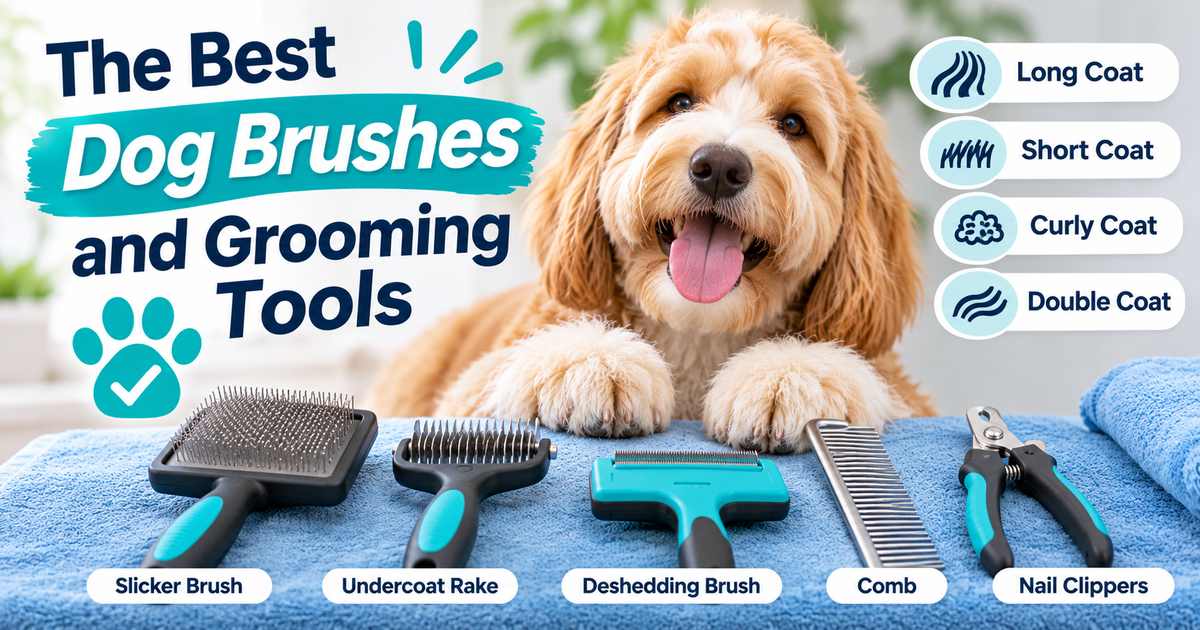
There is no best dog brush, only the right brush for a particular coat. That is the thing most buying guides skip, and it is why so many owners end up with a drawer of tools and a dog that still mats. A slicker brush is excellent on a curly coat and close to useless on a dense double coat. An undercoat rake clears a shedding retriever and does nothing for a silky terrier. Buying by review score produces a tool that works well for somebody else’s dog. Buying by coat type produces a tool that works for yours. Here is how to tell which coat you have and what actually belongs in the drawer.
Work Out Your Dog’s Coat First
Everything else follows from this, and it takes about ten seconds to check.
Part the coat with your fingers and look at what is underneath. If there is a soft, dense layer beneath a coarser outer layer, that is a double coat. If the hair is the same texture all the way down, it is a single coat. Then look at the texture and length of what you see.
That sorts most dogs into one of five groups:
- Short smooth coats, which shed constantly and tangle almost never
- Double coats, with a dense undercoat that sheds in volume
- Curly and wavy coats, which hold shed hair in the curl instead of dropping it
- Long silky coats, which tangle at the friction points
- Wire coats, which are coarse and benefit from a different technique entirely
Mixed breed dogs often sit between two of these, and the practical answer is to buy for whichever description fits what you are actually finding on the floor or in the coat. Hair on the furniture points to shedding tools. Knots in the coat point to detangling tools.
What Each Tool Does
Five tools cover almost everything, and knowing what each one is for prevents most wasted purchases.
A slicker brush has fine bent wires set close together on a flat or curved head. It reaches into coat and pulls out loose hair and small tangles. It is the main tool for curly, wavy and long coats, and it is largely surface work on a dense double coat.
A pin brush looks like a human hairbrush with widely spaced pins, often tipped. It is gentler than a slicker and suits long silky coats where a slicker would be harsh, as well as finishing work.
An undercoat rake has a single or double row of long rounded teeth. It passes through the outer coat and pulls dead undercoat from underneath. It is the main tool for double coats and does very little on anything else.
A greyhound comb, which is a metal comb with fine teeth at one end and wider at the other, is the one tool that works on nearly every coat. It is not really for brushing. It is for checking, which is covered below.
A bristle brush or rubber curry is for short smooth coats, lifting loose hair and spreading skin oils. Neither reaches far enough to matter on a long coat.
The Right Tools by Coat Type
Matching the list above to the five coat groups gives a short shopping list for each.
For short smooth coats, a rubber curry brush or a bristle brush and a comb is the whole kit. These coats shed steadily and need little else.
For double coats, an undercoat rake and a slicker brush, with a comb to check the work. The rake does the real work and the slicker tidies the surface.
For curly and wavy coats, a slicker brush and a greyhound comb, used together every time. This is the coat type where the comb is not optional, for reasons explained below.
For long silky coats, a pin brush, a slicker for problem areas, and a comb. Gentler tools suit these coats, which damage more easily than they look like they would.
For wire coats, a slicker, a comb and a stripping tool if you intend to maintain the texture. Clipping a wire coat softens it permanently, which is a decision worth understanding before you make it rather than after.
If none of this matches what you are finding on your dog, the coat may have changed, which happens around the first year and again with age. A groomer at a Dog Grooming Miami salon can tell you what you are working with in about thirty seconds.
The Comb Is the Tool Everyone Skips
If you buy one thing after reading this, buy a metal comb.
The reason is that a brush tells you nothing about whether you finished. Brushes glide over the top of a mat, flatten the coat above it, and leave you with a dog that looks beautifully groomed and is felted solid underneath. That is the single most common surprise at drop-off, and the owners are almost never neglectful. They brushed. The brush lied.
A comb cannot do that. Run it from the skin outward and it either passes or it stops. If it stops, the brush missed that spot and the coat needs more work there.
Use it as a check rather than as the main tool: brush a section, then comb that section before moving on. If the comb will not pass, go back. This one habit prevents most matting in dogs that otherwise turns into a shave down.
Tools That Cause More Harm Than Good
A few popular items are worth approaching carefully.
Bladed deshedding tools cut hair as well as pull it. Used lightly on a double coat once a week they are fine. Used daily with pressure they thin the guard coat and leave the skin sore, and the damage takes months to grow out.
Mat splitters and dematting rakes have hooked blades designed to cut through a mat. They work, and they are also how dogs get cut, because skin lifts into the base of a mat and is invisible from above. These belong in experienced hands.
Scissors near a mat are the most common cause of home grooming injuries that end at an emergency vet. The mat and the skin are not separable by eye.
Human brushes and combs are usually too soft, too widely spaced, or too fine for a dog coat, and human shampoo is formulated for different skin.
What Else Belongs in the Drawer
Beyond brushes, a small set of extras covers most between-appointment maintenance.
Worth having:
- A detangling spray, used on the coat before brushing rather than on a dry tangle
- A dog shampoo suited to the coat and skin, not a human one
- A microfiber towel, which pulls far more water out than a cotton towel
- An ear cleaner made for dogs, used on the schedule your vet sets
- Nail clippers or a grinder, plus styptic powder in case of a nick
- A non-slip mat for the bath or the table, which reduces a lot of anxiety
Nail tools come with a caveat. Clippers are faster and a grinder is harder to go too far with, and either works if the dog is comfortable with the process. If your dog is not, that is a handling problem rather than a tool problem, and forcing it tends to make the next attempt worse. Regular Dog Nail Trimming in Miami is a reasonable alternative for a dog with strong opinions about having its feet held.
What About Natural Grooming Products?
Worth a straight answer, since the question comes up often.
Products marketed as natural typically use plant derived cleansers, botanical extracts and plant oils in place of synthetic detergents and fragrances. Some suit sensitive skin well. The label itself is not regulated in any meaningful way, so it tells you about marketing rather than about contents.
Natural also does not mean safe by default. A number of essential oils commonly added to natural ranges are irritating or toxic to dogs, and some pet shampoos still contain them. What actually matters is the ingredient list, whether the product is formulated for dogs rather than adapted from a human one, and how your dog’s skin responds. If your dog has skin issues, the shampoo question is one for your vet rather than for a shelf label.
Buying Tools in Miami
The honest summary is that two or three good tools chosen for your dog’s coat will outperform a drawer full of whatever was on offer. A brush that suits the coat, a metal comb to check the work, and the habit of using the comb are most of what home maintenance requires.
If you would rather have someone look at the coat and hand you the right tool than guess from packaging, our Pet Store in Miami is at 275 NE 18th St in Edgewater, and the staff can match a brush and comb to what your dog actually has. Questions and appointments on (786) 409-2885 or through the booking page.
Frequently Asked Questions
What is the best brush for a dog that mats?
For curly and wavy coats, which mat most, a slicker brush paired with a metal greyhound comb. The slicker does the brushing and the comb checks the work, since a brush passes over a mat and leaves the coat looking finished. If the comb will not reach the skin and pass through, that section is not done.
What supplies do I need for grooming a dog at home?
A brush suited to the coat, a metal comb, a detangling spray, dog shampoo, a microfiber towel, an ear cleaner made for dogs, and nail clippers or a grinder with styptic powder. A non-slip mat helps more than most owners expect. Tools beyond that are mostly optional.
Is a deshedding brush bad for dogs?
Not when used correctly. Bladed deshedding tools cut hair as well as pull it, so light weekly use on a double coat is fine while daily use with pressure thins the guard coat and irritates the skin. An undercoat rake is gentler for regular use, and neither tool should go through a matted coat.
Can I use a human hairbrush on my dog?
It will not do much. Human brushes are generally too soft or too widely spaced to reach a dog’s undercoat, and human combs are the wrong spacing for most coats. Human shampoo is also formulated for different skin, so it is not a substitute even for an occasional bath.
Leave A comment